

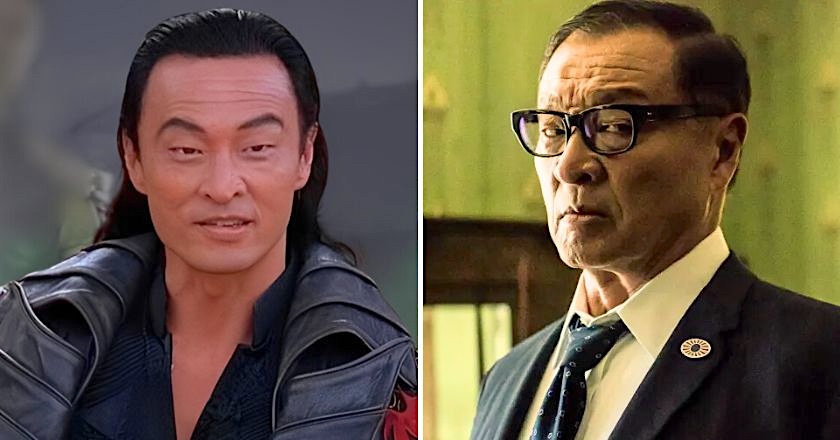
“Mortal Kombat” Carrie = Hiroyuki Tagawa (left) and “The Man in the High Castle” (right)
Japanese American actor Cary Hiroyuki Tagawa has passed away. Its presence may make the supporting characters something to remember on the way home from the movie theater. The “Mortal Kombat” and “The Man in the High Castle” star died Thursday in Santa Barbara of complications from a stroke. He was 75 years old.
From Tokyo to Oscar-winning blockbuster
Born in Tokyo to a military family, Tagawa spent his childhood moving around the country until his family finally settled in the United States. He attended high school in Southern California and then enrolled at the University of Southern California, where acting and martial arts began to take shape as twin callings.
His breakthrough came with Bernardo Bertolucci’s 1987 historical drama The Last Emperor, which went on to win nine Academy Awards, including Best Picture and Best Director. In a 2015 interview with The AV Club, he recalled the surreal thrill of landing the job early in his career, saying, “It was mind-boggling. You know, all of a sudden I was working with one of the top 10 directors in the world, and the movie was going to be made in China, and I couldn’t help but blurt out, ‘How much do I have to pay?’ It was like a dream come true.”
More roles for big studios followed, and Tagawa frequently appeared in stories where Asian and Western cultures collided. He played the ruthless patriarch Heihachi Mishima in the James Bond film “License to Kill,” Michael Crichton’s “Rising Sun,” the war dramas “Pearl Harbor” and “Snow on the Cedars,” Tim Burton’s “Planet of the Apes,” the comic book adaptation “Elektra,” and the video game adaptation “Tekken.”
Shang Tsung, cult status and ‘game changer’
For many fans, Tagawa will always be associated with the character of Shang Tsung. His role as a soul-stealing sorcerer in the 1995 Paul W.S. He has returned to Shang Tsung numerous times throughout the property’s film, television, and video game incarnations, including Mortal Kombat: Annihilation, Mortal Kombat: Legacy, Mortal Kombat X: Generations, and the hit fighter Mortal Kombat 11.
Tagawa never underestimated what the character had given him. On revisiting Shang Tsung for a new generation of fans, he said of reprising the role of Shang Tsung, “Oh, it was a pleasure.” “I think this just gave me an opportunity to refresh for a new generation. And I think it’s going to continue because the game keeps getting bigger. This has definitely been a big part of my career, but so have a lot of these movies that I’ve been in. I’ve been in a lot of cult movies, and I’ve been very fortunate to be able to work on projects that people will remember.”
He also recognized how perfectly the original film landed in pop culture. “At the time we made this movie, ‘Mortal Kombat’ was in the fourth or fifth place as a video game, and the influence of the movie was definitely relevant to how video games were built, so it was perfect timing,” Tagawa later said. Praising Anderson’s approach, he added, “He was the first in the history of martial arts to apply that kind of music. It’s really upbeat, driving metal music. When you hear that music, you can’t sit still. And it suited the action very well.”
Martial Arts, “The High Castle” and Life Between Worlds
Tagawa’s physical abilities are the result of a lifetime of training. “I was born in Tokyo and started Kendo when I was in middle school,” Tagawa recalled in a 2010 interview. “Then, when I was five years old, I moved to Fort Bragg, North Carolina. That’s where I got my first real lessons in how to use martial arts. Being Japanese and living in the South in the ’50s was pretty tough.” At USC, he concentrated on traditional Japanese karate, then returned to Japan to study under Shihan Nakayama of the Japan Karate Association. He would later develop his own system, Chunshin, which he described as “a study of energy without any concept of physical combat.”
Television gave him just as much opportunity to stretch. For 40 years, Tagawa has starred in series such as Miami Vice, MacGyver, Baywatch, Nash Bridges, Hawaii, Revenge, Lost in Space, and Star Wars: Rebels. He has also appeared in animated projects such as “Ninja Turtles”, “Teenage Mutant Ninja Turtles”, and Netflix’s acclaimed samurai saga “Blue Eyed Samurai”, where he voiced the Swordmaker.
His last major live-action role was one of his richest, as Trade Minister Shinsuke Tagami in the Philip K. Dick film adaptation of The Man in the High Castle on Amazon. Playing a conflicted bureaucrat in an alternate history world carved between Nazi Germany and the Empire of Japan, Tagawa brings quiet melancholy and moral complexity to the role of a would-be stock bureaucrat.
His role in this series reflected his own history. “I identified with this character and a lot of my own life experiences. I was born in Tokyo, came to America right after the war, 10 years after the war, and I’ve grown up understanding the legacy of war. So, the good, the bad, the ugly, the different, just like my character Tagomi, who seems to be the only one running around talking about peace.”
A “rare soul” to be remembered
Beyond his credits and cult status, his colleagues describe him as a generous collaborator and fiercely dedicated artist. “While I have had the privilege of representing Cary Hiroyuki Tagawa for many years as his longtime manager, our relationship has grown deeper and he has become like family,” Tagawa’s manager Margie Weiner said in a statement. “Cary was a rare soul, generous and thoughtful, and infinitely dedicated to his craft. My thoughts are with his family, friends, and everyone who loved him.”
Mr. Tagawa and his wife, Sally, settled on the Hawaiian island of Kauai, where they raised their family. Away from the set, he continued to teach, explore spirituality, and refine his martial arts philosophy, building a life that sat comfortably between Hollywood, Japan, and the Pacific Ocean.
Cary Hiroyuki Tagawa is survived by his wife, Sally; his children, Karen, Bryn and Kana; and grandchildren, River Clayton and Thea Clayton.
