

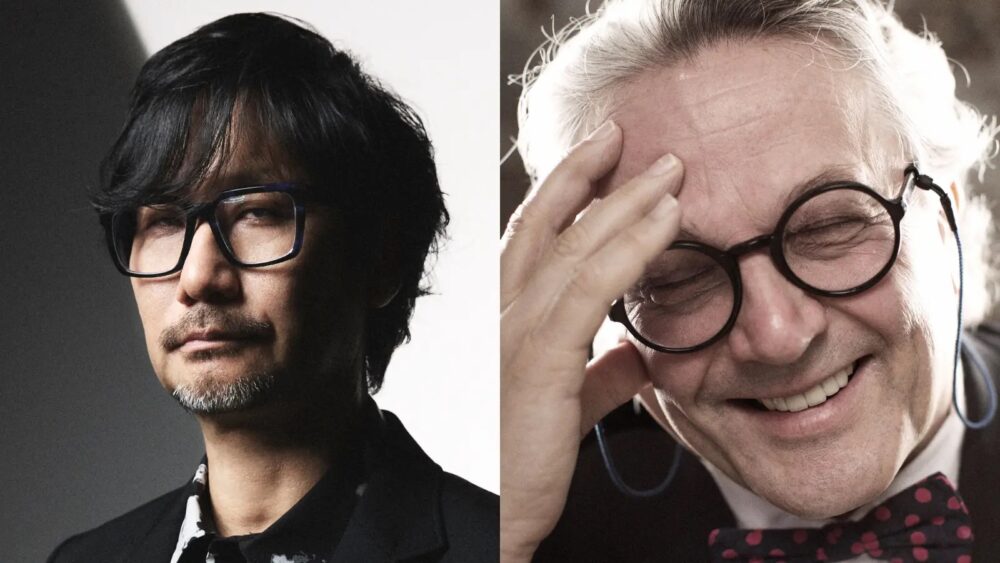
Credit: Sydney Film Festival
The crossover between Australian film legend George Miller and Japanese video game is odd to those unfamiliar with two people beyond their main productions, but for those who follow closely, this is a relationship that goes back more than a decade. And considering both of those careers and creative output, it’s easy to track connections that go far beyond just these two master creators.
Kojima first saw Miller “meet” as a teenager, Mad Max (1979) and Mad Max 2 (1981). It may not have been directly, but it is a kind of encounter in itself that allows one to sink into another’s creative vision. Not only is Miller’s creative vision on display, but he also takes on, interprets, rethinks, rethinks, and essentially assumes the role of the creator himself, as he takes on what the viewer, in this case the younger Kojima, saw.
In an hour-long (still short) conversation at this year’s Sydney Film Festival, Kojima and Miller not only repeated mutual praise, but also talked about the diverse and convergent nature of films and video games, the importance of the story being told, and how to portray the medium in the future, a measurement of Kojima’s future future, and a measurement of the future.
Here are some key points from this world-exclusive event:
1. Kojima’s choice of Australia as a death environment 2: On the beach, more than a postcard view
In Death Stranding (2019), players crossed the US. For the sequel, Kojima chose Australia. When asked about this decision, Kojima joked because he “loves Miller.”
He expanded further, explaining that topographical density and diverse flora and fauna were the first to be interested in him. The uniqueness of our marsupials also attracted attention for Kojima, citing both their unique appearance and pouches. He even argued that the presence of many iconic animals in Australia exists on the beach along the death 2: 2.
2. Both creators frame connections and quarantine as master themes in our era
When focusing on the dichotomy of separation and connections that exist in the overseer of death, Kojima described his stick-and-rope “schema.” Fans have heard what they explained before, but essentially comes from the idea that humans use sticks to fight evil and ropes, keeping things they love closer.
He expanded this in the context of the first concept of ideas he had in 2016, comparing it to Brexit, the election of Donald Trump, and our general discussion of overconnection through the internet. It is almost poetic that the same dichotomy was amplified only during the pandemic, shortly after the initial release of death.
Miller told the story of her father on his final days with his youngest son. During his final days, the boy chose to play video games. That was what he could beat. Miller emphasizes us as an example of the power that connects us with the interactive elements that video games have.
3. Video games are expanding on how movies use storytelling
Miller also discussed the nature of video games and how they become more like films of their visual and production quality, but provided agencies that are almost impossible in films. This ability to participate in this story is also very important to Kojima. Especially difficult as a video game creator who tries to ensure that his story is being told without completely dictating his story choices.
He explains this better using highway ratio phors, explaining that most games that assume the ability of players to choose their own paths are “highways with designated exits.”
Kojima outlined his ambition to create a structure in which the author’s story remains intact, but the approach is much more adaptable.
4. The two media are technically converging, but empirically diverging
Miller points out that films and games are both digital media made with the same tools. But at their core, the experience is different. The film is a passive transport, and the game is an active story building.
They see the future agrees to increase hybridization – an AI-supported personal film or a game with an Auto-level personality – and the distinction between watching and playing remains in two separate art forms.
5. Storytelling is positioned not as decorative art, but as the oldest adaptation strategy for humanity.
These two are not the first to mention how they are burned into the storytelling of the human mind. Miller correctly points out that Australia is built on the land of people with the oldest and most continuous storytelling.
When you think about it, movies and video games are two modern ways we invented to tell our stories. The film is only 125 years old, and the video games are much older than the age of 50. Video games are an extension of the film, and now they’re becoming more and more equally unique. Both creators acknowledge that Miller’s film and Kojima’s games are not answers to life questions and are not special to technology.
But they are storytellers today, and will follow the tradition that has lasted for as long as humans exist, regardless of technology, and will continue onwards from now on.
The Sydney Film Festival took place from June 4th to June 15th. Check out other reports from the festival here.
